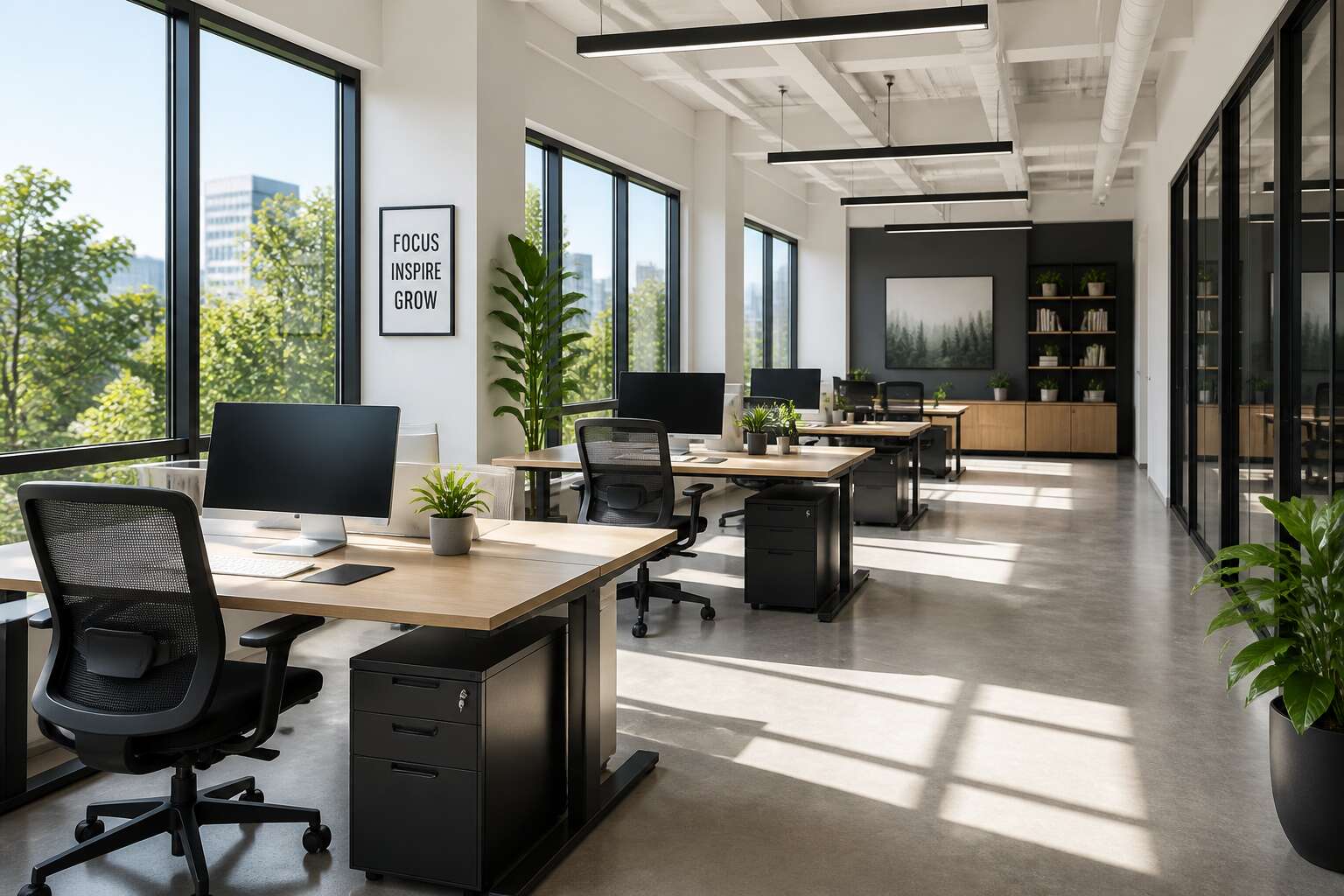
Understanding Your Office Space Requirements
Assessing Team Size and Layout Preferences
The average South African team has shrunk by a third since 2020, which means the space you once needed for desks must now accommodate different rhythms of work. Understanding your office space requirements starts with asking who actually comes in daily and what they do when they arrive.
Team size determines layout more than any design trend. A squad of eight handling client calls needs soundproofed corners. A creative team of fifteen thrives on shared tables and writable walls. Before signing anything, map these factors:
– Daily attendance patterns, not total headcount
– The percentage of work requiring deep focus versus collaboration
– Storage needs for files, equipment, or inventory
This clarity transforms rent office use from a transaction into a strategic decision. When you match square metres to actual behaviour, you avoid paying for empty chairs while giving your people space to work properly. Accurate measurement prevents costly mistakes.
Location Considerations for Your Business
Nothing sinks a brilliant office plan faster than a terrible location. You have measured your team’s flow, planned for collaboration and focus, and then someone points out the nearest coffee shop is a thirty-minute walk through a construction site. The physical address of your workspace defines how your people start and end their days, which shapes their energy, their punctuality, and their willingness to come back tomorrow.
Accessibility matters more than prestige. A flashy Sandton address loses its shine when your staff spends two hours in traffic to reach it. Consider the daily friction points that make people dread their commutes and the solutions that make them tolerable:
- Proximity to major transport hubs like Gautrain stations or BRT routes
- Parking availability, which is the unofficial currency of Cape Town’s CBD
- Safety of the surrounding block after dark, especially for evening shifts
Your clients also factor into this equation. A location that impresses investors but frustrates your daily users is a hollow victory. The best rent office use balances convenience for your people with the practical needs of your customers. Sometimes a modest building near a main artery outperforms a landmark tower tucked into an awkward one-way system. The neighbourhood noise, the lunch options, the delivery access, they all contribute to the daily experience of working there. Get the location wrong and no amount of clever interior design will rescue your rent office use strategy.
Budgeting for Office Rent and Additional Costs
Hunting for office space is a journey of discovery, mostly about how much you don’t know about your own budget. The rent quoted on the listing is merely the opening act. The real financial drama unfolds with operating costs, which landlords in Johannesburg or Durban can calculate with the mystery of a casino. Your monthly liability often hinges on the building’s consumption of water, electricity, and security, which is metered and apportioned. Demand a clear breakdown before you sign anything.
Beyond the base rate, you must fund your outfit with the necessary accoutrements for daily commerce. Think about the practical costs that often slip through the cracks:
– Parking rental for staff, which can be exorbitant in city centres.
– Backup power solutions, which are no longer a luxury but a necessity for load shedding.
– High-speed fibre, which is the lifeblood of your operations and is rarely free.
These recurring expenses have a way of accumulating swiftly. Your total cost of occupation can easily exceed the headline figure by 30% or more. That bargain space in a less fashionable suburb might still offer the best total cost, however. The smart strategy is to work backwards from your projected monthly outlay, including property rates and VAT, to calculate the true price of your rent office use. Only then can you compare spaces on an honest footing.
Short-Term vs. Long-Term Office Rentals
Flexibility costs money. In South Africa’s commercial property market, that cost often dictates your lease term. Short-term rentals, typically six to twelve months, suit startups testing their operational footing. Landlords know this and charge a premium. Long-term leases, five years or more, unlock lower monthly rates, but they lock you into a space that may not fit your growth. Consider how your rent office use evolves over time. A short lease gives you room to pivot, while a long lease demands certainty about your future headcount and workflow.
If you are weighing options, think about these factors:
- Break clauses and their penalties.
- Subletting permissions.
- Renewal rent escalation clauses.
Signing for a longer term when you are unsure about your staffing is risky. Short-term flexibility lets you adjust, but it costs more per square metre. Match your lease length to your business’s actual trajectory, not your hoped-for one.
Identifying Must-Have Amenities
Your office space needs to breathe with your business, not against it. A simple rule: measure your equipment, storage, and movement paths, then add a third for breathing room. Most South African businesses discover that square metre costs matter less when the layout actually works.
Amenities shape daily operations. Evaluate what your team genuinely uses:
- Reliable fibre and backup power
- Secure parking and access control
- Natural light and ventilation
- Kitchen or break areas
These elements directly affect productivity and morale. When you plan your rent office use, let these requirements guide your search. Spaces with the right amenities reduce hidden renovation costs and keep your operations running smoothly.
Types of Office Spaces Available for Rent
Traditional Private Offices
According to a recent survey, nearly 60% of South African employees say they focus better behind a closed door. That is where traditional private offices shine! You get four walls, a door that actually shuts, and a space to think without your colleague’s protein shake gurgling in the background. These offices come in various sizes, from compact rooms for solo operators to larger suites for management teams. They offer privacy for confidential calls, focused work, and the occasional burst of singing to your playlist.
Consider what you are getting into with rent office use. A traditional private office usually includes a lockable door, dedicated climate control, and a window if you are lucky. The real appeal is the separation from the hustle. You can close the door when you need, and open it when you want company. That flexibility is worth a lot in a world of open plan layouts.
Coworking Spaces and Shared Desks
Then there is the alternative: coworking spaces and shared desks. These environments trade the closed door for a dense mix of human activity. You rent office use here for the presence of others working toward their own goals, not for silence.
Shared desks are the most transient option. You claim a spot for a day, a week, or a month. No roots, no territory. Coworking spaces, by contrast, offer a fixed seat within a larger community. Both force you to confront how much background noise you can absorb before your concentration breaks.
- Open benches with power points
- Communal tables for spontaneous conversation
- Quiet zones for those who need partial focus
This arrangement suits people who thrive on incidental contact. When you rent office use in a shared space, the stranger beside you might become a collaborator, or just a reminder that you are not alone in your daily work.
Virtual Offices and Service Offices
Virtual offices solve the problem of a business that wants to look established without taking a lease. Your letterhead shows a Sandton address, the reception line is answered by someone you will never meet, and mail arrives as a scanned file. When a client asks for a meeting, you rent office use by the hour. A boardroom, a projector, and a jug of water appear. Then the session ends, and so does your physical presence.
Service offices take the same arrangement and make it tangible. You hold a keycard. The reception desk is staffed, the printer speaks your language, and the meeting room tracks your bookings. You rent office use as a continuous service. The single monthly fee covers furniture, cleaning, security, and the person who replaces the bulbs. You arrive with a laptop, and nothing else.
Standard packages for both options include this support:
- A reception desk active during your working hours
- Mail and parcel handling under your company name
- Meeting room access whenever a negotiation requires it
Serviced Offices vs. Conventional Leases
Renting office space in South Africa often feels like a choice between committing to a decade long relationship or a brief, transactional fling. A conventional lease is the former. You sign, you pay a deposit, and you accept that the boardroom with the broken air conditioner is your problem for the next five years. Studies show that over 90% of office space in Sandton CBD has been vacant for several years, yet landlords still demand a 3 year commitment. It is a strange market where the supply is high, but the flexibility is low.
Serviced offices offer a different path. When you opt for rent office use on a monthly basis, you are paying for a utility, not a liability. The lease covers a fraction of the space, and the management company absorbs the risk of the empty floors above you. This model works well for those who understand that a business plan changes faster than a lease negotiation.
The difference comes down to control and cost. A conventional lease gives you the authority to hang your own art on the wall. It also gives you the obligation to fix the plumbing when it fails. With serviced offices, the equation is simpler:
– Your monthly fee includes the office, the furniture, and the WiFi.
– The service provider handles the building maintenance and the rates.
– You retain the ability to cancel or downsize with thirty days notice.
– The per square meter cost is higher, but the incidental costs are close to zero.
This structure converts a fixed overhead into a variable cost. Instead of committing capital to fit out a space, you commit to a service level. For a growing company, the ability to rent office use by the day or the hour removes the anxiety of paying for empty desks. The meeting room you book on Tuesday is the same one you vacate before the coffee has cooled.
Executive Suites and Managed Workspaces
Most companies that need a private office do not actually need a full floor. Executive suites sit between the open plan of a coworking space and the rigid walls of a conventional lease. You get a turnkey, furnished office inside a building that also offers shared reception, boardrooms, and kitchen facilities. This arrangement is common in Sandton and Cape Town CBDs.
Managed workspaces take this further. The provider assigns a dedicated team to handle your admin, IT, and visitor management. You focus on operations while the building runs behind you. This type of rent office use suits law firms and consultants.
- Reception and mail handling come standard.
- Meeting rooms are available on demand.
- Scaling up or down is often a matter of weeks.
Both options allow rent office use without the long-term liability of a conventional lease. The difference is the level of service. Executive suites give you space. Managed workspaces give you a back office.
Key Factors to Evaluate Before Signing a Lease
Lease Terms and Flexibility
The standard lease in South Africa often requires a three year commitment. Yet a significant number of small businesses change their operational footprint within the first eighteen months. That mismatch causes many entrepreneurs to pay for empty floors.
Your rent office use today might not match your headcount next year. Often, I tell business owners to treat the exit clause as the most important paragraph in the document. Negotiate the notice period in months, not vague legal terms. Understand what happens if you need to exit early. Some landlords will assign the lease to a new tenant, which provides a useful escape hatch.
- Verify renewal options are stated explicitly.
- Clarify if you can sublet unused space.
- Check the escalation formula; fixed percentages lack surprise.
This clarity protects your deposit and your financial security during uncertain economic cycles.
Hidden Costs and Utility Expenses
Most tenants focus on the headline price per square metre. The real cost of rent office use in South Africa hides inside the fine print of utility clauses. Load shedding pushed many businesses to install inverters, but the baseline electricity tariff still lands on your account. Ask whether the building charges a utility levy or bundles it into the service fee. Municipal rate increases pass through annually, often uncapped.
I have seen landlords charge a fixed utility amount, then reconcile it at year end. That invoice can hurt. Check whether water and refuse are itemised. Some complexes add a parking fee per bay. Others demand maintenance contributions for shared air conditioning.
Consider these points:
- Is the electricity meter sub-metered or based on building ratio?
- Who replaces light bulbs and minor plumbing parts?
- Can the landlord raise utility charges at discretion?
These factors alter the true cost of rent office use more than the base quote.
Office Layout and Customization Options
The lease’s fine print will decide whether you can knock down a wall. I have watched businesses sign a five year agreement without checking the make good clause. That oversight can cost you the deposit and more! Evaluate three factors before you commit:
- Does the lease allow structural changes or only cosmetic touches?
- Who pays for restoring the space to its original condition?
- Are there restrictions on sub-metering or installing dedicated HVAC?
Customization options vary wildly between buildings. Some landlords offer a tenant installation allowance, others demand you pay for every partition and data point. In South Africa, many offices still come with drop ceilings and fixed cubicles, which limits your ability to reconfigure. Ask about the building’s floor plate and column spacing. These physical constraints dictate how far you can adapt the space for rent office use. If your business needs open areas or private pods, verify zoning and building regulations before signing.
Building Infrastructure and IT Readiness
Eskom’s load shedding schedule has rewritten lease negotiation priorities, yet tenants still sign without checking backup power capacity. Your rent office use depends on more than square metres and paint colours. Fibre availability, UPS systems, and generator run times determine whether you’re productive or staring at a dark screen.
Before you commit, interrogate these infrastructure details:
- Does the building have redundant fibre entry points, or one fragile cable?
- Is there a dedicated electrical sub-board for your floor?
- What is the generator’s fuel autonomy during extended outages?
A building advertising 100 Mbps might route all connectivity through a single point of failure. Also verify the HVAC can handle your server room’s heat. South African summers punish inadequate cooling, and so does a landlord who never upgraded the system. Your rent office use demands electricity that actually flows.
Accessibility and Parking for Employees and Clients
Every morning commute in Johannesburg or Cape Town is a negotiation with time itself. Load shedding has rewired traffic patterns, so what looked like a convenient location at 9 AM might be a gridlocked nightmare by 4 PM. Your rent office use depends heavily on how easily clients can actually reach you.
Parking is the silent contract nobody reads. A building with 200 parking bays for 40 tenants sounds adequate, but vertical office blocks rarely accommodate visitor overflow. Consider the daily reality of your staff driving in from Soweto, Centurion, or Durbanville. If they arrive to circling blocks and paid parking at R30 per hour, your office becomes a tax on their patience.
– Visitor bays: are they clearly marked and secure?
– Basement access: does the ramp accommodate bakkies or only low sedans?
– Security protocols: what happens after 6 PM when the night shift arrives?
– Public transport interface: is there a safe walking route from the nearest Gautrain or MyCiTi stop?
Accessibility also means disability compliance, wheelchair ramps, elevator dimensions, and accessible ablutions. Many older Parktown or Durban CBD buildings treat these as afterthoughts. Your rent office use must include the ability for every client to enter without assistance. The pavement outside matters too. Cracked sidewalks and missing streetlights turn a simple visit into a hazard. Landlords rarely mention these things during the tour. Ask about recent security audits and crime statistics for the immediate block. A cheaper rent on a dodgy street costs more in lost opportunities, insurance premiums, and staff safety. The physical journey to your office is part of your brand experience. Make sure it doesn’t tell clients to stay away.
Legal Considerations and Zoning Regulations
Before you sign anything, the zoning certificate tells you what the property legally permits. Your rent office use might seem straightforward, but a building zoned for light industrial will not accommodate a medical practice. Check the title deed and the municipal zoning scheme. Ask the landlord for approved plans and the occupancy certificate. I have seen tenants skip this step.
The lease itself carries clauses worth scrutiny. Subletting rights, renewal options, and penalties for early exit shape your flexibility. Some landlords require personal suretyships that expose your assets. A property lawyer can flag these provisions before you commit.
Consider these legal points:
- Permitted use and contravention penalties
- Renewal terms and escalation clauses
- Liability for municipal rates and taxes
- Compliance with the National Building Regulations
Many tenants discover their rent office use breaches the zoning category only after the deposit is paid.
How to Optimize Your Rented Office for Productivity
Designing Functional Workstations
Productivity in a rented office often depends on the setup of each workstation. For rent office use, the arrangement of a desk, chair, and screen determines whether focus flows or fractures. Assigning tasks to specific zones based on natural light and foot traffic gives an ordinary floor a clear purpose.
In my experience, South African offices under load shedding force workers to rely on laptops and rechargeable lamps, so power access and cable routing deserve careful attention. The distance between collaborative tables and quiet pods influences how easily teams shift between modes of work. Optimizing rent office use means treating every workstation as part of a connected system.
- Ergonomic chairs with adjustable lumbar support
- Monitor arms that free up desk surface
- Acoustic panels near high-traffic areas
These small details accumulate into a functional whole. Each square meter in a rented space then works harder for the people using it.
Incorporating Meeting Rooms and Breakout Areas
In a rented space, productivity is rarely a product of sheer square footage. It emerges from how meeting rooms and breakout areas channel human energy. The best rent office use recognises that a conference table can inspire or inhibit, depending on its connection to quieter zones.
Breakout areas need to feel like a release valve, not a dumping ground. In South Africa, where load shedding interrupts rhythm, these spaces should offer solar lamps and power banks. The flow between focused work and spontaneous discussion depends on deliberate placement:
- Meeting rooms pushed to the perimeter, away from heavy foot traffic
- Glass partitions that preserve visibility while blocking noise
- Breakout corners with writable walls for impromptu sketches
Such arrangements make every square metre serve a distinct purpose.
Leveraging Natural Light and Ergonomics
Sunlight in a Johannesburg office isn’t a luxury; it’s a daily requirement. I’ve seen how a desk near a north-facing window changes the day’s rhythm. Natural light cuts eye strain and lifts alertness, which makes rent office use more efficient. But brightness needs a complement: ergonomic chairs with lumbar support, and adjustable monitors at eye level.
Consider these adjustments for your rented space:
- Position desks perpendicular to windows to avoid glare.
- Use matte screens to reduce reflections.
- Place footrests under taller employees.
Small changes cost little, yet they compound. One client told me her team’s afternoon slump vanished after we swapped fluorescents for task lamps. Rented offices feel temporary, but your body remembers every uncomfortable hour. Prioritise light and posture, and every square metre pays you back.
Technology Integration and Connectivity
Load shedding once dictated office hours in Johannesburg, but today poor connectivity steals more of them. A single dropped video call costs more than a minute. It erodes client trust. Your rent office use should never suffer because of a building’s outdated network core.
Ask about the backbone before you sign. Is there dedicated fibre? Are power points wired to inverters? Do meeting rooms have discrete access points? These questions reveal whether the space supports your workflow or undermines it. A thoughtful approach to rent office use means testing the network at peak hours.
Latency matters more than raw speed. Cloud tools punish every delay. A building with congested routing turns simple uploads into endurance tests.
Review these technical details:
- Bandwidth allocation per tenant
- Network redundancy across multiple providers
- Signal boosters for mobile coverage
I once toured a serviced office advertising gigabit fibre. The lobby speed test passed. The corner conference room collapsed. Technology integration cannot rely on one access point. Test the spaces you will use.
Implementing Smart Storage Solutions
Designing a productive space goes beyond furniture. Your rent office use lives or dies by how quickly your team can find what they need. A cluttered floor plan forces productivity into retreat, every lost document an ambush waiting to happen. Chaos drains morale faster than any commute ever could. Make the space work around your workflow, not against it.
Storage is the silent foundation of that workflow. Observing a few practical rules can transform how your team operates:
– Assign dedicated digital and physical homes for every project.
– Choose vertical storage to protect your floor space.
– Invest in lockable cabinets for sensitive client files.
– Review your inventory quarterly to discard the unnecessary.
Smart shelving reduces noise and visual clutter. It allows your team to focus on the work itself, rather than the archaeology of finding last week’s reports. Rethinking your rent office use around these principles turns wasted square metres into a powerful asset for your daily operations. A tidy environment gives your business breathing room that translates directly into sharper focus and faster turnaround times.
The Future of Office Usage and Rental Trends
Hybrid Work Models Impact on Office Space
Recent employment data in South Africa suggests that 68% of companies now allow employees to work remotely for at least two days each week. This single shift is rippling through the commercial property sector. I have watched small business owners sign leases based on headcount, only to see half the floor sit idle by Thursday afternoon. That is why rent office use is starting to mirror actual attendance, rather than the other way around.
Hybrid work models give the office a new rhythm. Monday can be quiet, Tuesday shared, and Friday left empty. A fixed footprint is no longer a symbol of success; it becomes a weight when no one is around for it.
- Short-term meeting rooms for team sprints.
- Secure storage that scales down as digital files grow.
- Shared entrance and lounge space for clients who visit on the fly.
The future of offices belongs to those who observe these patterns, then adapt their real estate decisions with care.
Sustainable and Eco-Friendly Office Design
Eskom’s load shedding forced a hard conversation across the commercial property sector. Companies now expect rent office use to cover servers, air conditioning, and lifts, but the wiser landlords are pressing across the table about where that electricity comes from. A lease no longer signals location prestige; it signals operational judgment. I toured a Johannesburg building where the diesel bill alone had doubled and the landlord was still charging tenants for voltage spikes.
- Rooftop solar arrays sized to a building’s peak load
- Rainwater harvesting feeding the greywater system
- Cycling bays that reduce parking demand
Offices that ignore these signals will face rising vacancy risk when tenants measure a property’s total carbon footprint. The next contract cycle will put eco-friendly design at the centre of negotiations for rent office use across South Africa’s major metros.
Technology-Driven Office Management
Leases are becoming instruments of precision, not mere formalities. The office of tomorrow demands intelligence woven into its very bones. Smart sensors now track occupancy in real time, dimming lights in empty corridors and adjusting air flow to match breathing patterns. This transforms the cost structure of rent office use, turning static expenses into dynamic allocations tied to actual presence.
Data flows where people once walked. Building management systems, once crude mechanical hearts, now pulse with algorithmic life. They predict maintenance failures before they occurcing, reroute energy demands, and alert landlords to inefficiencies that silently drain budgets. Tenants who understand these systems negotiate better terms because they understand the true cost of every square metre.
- Occupancy analytics that reshape floor plates
- Predictive HVAC scheduling based on historical patterns
- Integrated booking platforms for shared resources
- Real-time utility dashboards visible to tenants
The rental market itself is shifting beneath our feet. Flexible terms now mirror the volatility of business planning. Some landlords offer usage-based pricing, where rent office use fluctuates with headcount, a strange but honest admission that rigid contracts no longer match how companies actually operate. Others bundle technology fees into base rent, hiding complexity beneath a single monthly figure.
Ghost squares haunt underutilised buildings. Smart meters expose them, revealing vast stretches of carpet rarely touched by human feet. Tenants now demand those spaces be reimagined or discounted. Property owners who ignore this reckoning watch their vacancy rates climb while smarter competitors harvest productivity data to justify every rand charged.
Choosing a Space That Scales With Your Business
The days of signing a lease and hoping your headcount stays static are fading. In South Africa, forward-looking businesses now treat rent office use as a dynamic arrangement, one that changes alongside their ambitions.
Scaling never follows a straight line. Some quarters demand more desks, others require fewer. The smartest tenants negotiate expansion clauses and contraction options before signing, not after.
Consider what genuinely matters for your future footprint:
- Breakpoints that trigger additional floor space
- Rights to sublease unused areas without penalty
- Terms that allow you to swap floors or buildings as teams grow
These provisions turn a fixed cost into a flexible resource. I have seen tenants secure these terms more often than they expect. When landlords resist, they reveal their own inflexibility. The right space should stretch, shrink, and adapt without punishing you!

0 Comments