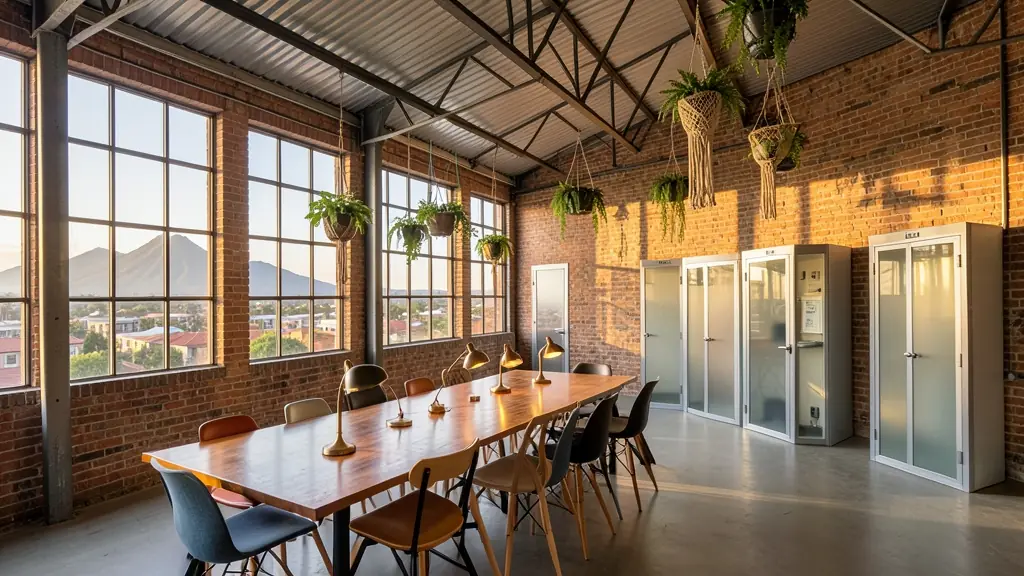
A coworking space sells you a seat on a shared floor rather than a room of your own. You join as a member, from a day pass to a fixed desk, and share the Wi Fi, the coffee, the phone booths and the meeting rooms with freelancers, remote workers and small teams. It is cheap to start and easy to leave, but it only works if the floor suits how you actually work, so try before you join.
Price guideA hot desk costs about R1,495 a month VAT included to R3,400 a month, and a dedicated desk about R2,700 a month excluding VAT to R4,985 a month on a monthly plan. Longer terms bring the monthly price downA rough guide from published South African prices. The area, the term, the grade, what is included and VAT all move it.
Membership tiers in plain words
- Day pass: walk in, find a free seat, leave at closing.
- Hot desk: a monthly membership with any free seat, sometimes limited to a number of days.
- Dedicated desk: the same desk every day, with a lockable pedestal.
- Studio: a small private room for two to eight inside the hub.
Most tiers come with meeting room credits a month and a locker for an extra fee. Check the access hours: a 24 hour card is often only on the higher tiers.
What to test on a trial day
Arrive at the time you normally would. Is there a seat, or is the hot desk area full before 9? Make a call from a booth and from the open floor, and check the cell signal. Ask what runs on the generator during load shedding, and whether the coffee is included or sold. Count the parking, then try the chairs for a full morning: a bar stool at a shared table does not work for eight hours.
Privacy on a shared floor
Anyone can read a screen over your shoulder. Take confidential calls in a booth, use a screen filter, lock papers away and ask whether the guest Wi Fi is separate from the members' network. A client who must not be overheard needs a meeting room, not a corner of the lounge. The community events, talks and Friday drinks are a bonus, not a reason to join.
When you outgrow the hub
Usually when a team of five or six is paying for fixed desks every month and still fighting for meeting rooms. That is the time to price a serviced office or a small lease on the serviced vs leased office tool.
Who asks for this
- Freelancers and one person businesses
- A hot desk a few days a week to escape the kitchen table and meet people.
- Start ups and small teams
- Three fixed desks or a small studio for a team still finding its size.
- Professional practices
- A dedicated desk for an adviser or designer who meets clients in booked rooms.
- Companies and head offices
- Satellite seats near home for staff who no longer drive to head office daily.
- Schools, NGOs and churches
- A cheap base for a small NGO team or a tutor running online courses.
- Branches and franchises
- A few desks for a sales team in a city where the firm has no office.
- Building sites, mines and farms
- A reliable desk with power and fibre for engineers between site visits.
- Event organisers
- A seat for freelance planners and a hub event space for a small launch.
Frequently asked questions
How do I find a coworking space near me?
Tell us the suburb, the number of seats, how many days a week and the tier you want. Operators in that area reply with their membership options and you can book trial days from there.
Can I rent a coworking space per day?
Yes, most hubs sell day passes and bundles of ten days a month. If you need a closed room for the day rather than a seat, see day office rental.
Is coworking space in Cape Town different from Johannesburg?
The models are the same. Cape Town has many hubs in converted warehouses in Woodstock and the city bowl, and Johannesburg has more in Rosebank, Braamfontein and Sandton. Parking and backup power vary more by building than by city.
Can I register my company at the coworking address?
Many hubs allow it on a monthly membership. A bank or SARS may still want proof of where you operate, so ask your bank and check with CIPC. A virtual office is the address only option.